
Categories

Description
Buy Sunflower Oil from Tanzania: The Complete 2026 Buyer’s & Importer’s Guide
Buy sunflower oil from Tanzania. Eco Edge Company Limited supplies high-quality, natural sunflower oil for export and local markets.
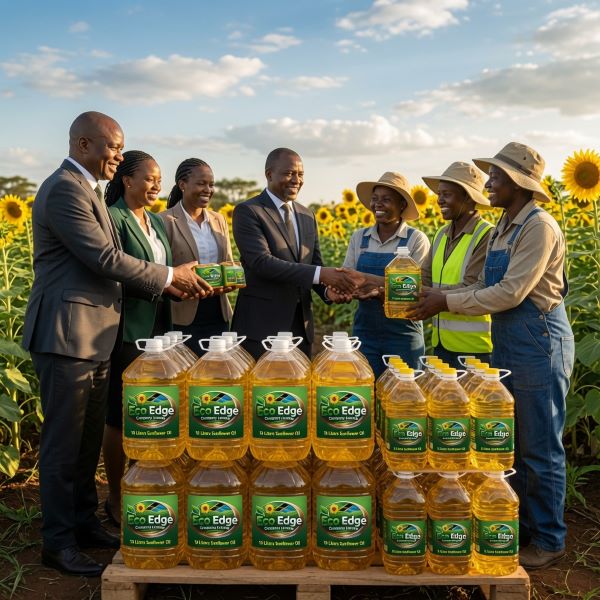
If you want to buy sunflower oil from Tanzania, you are sourcing from one of the top ten sunflower oilseed producers in the world — a country whose golden fields across Singida, Dodoma and Shinyanga feed a fast-growing edible oil industry supplying households, restaurants, food manufacturers and importers across East Africa, Europe and Asia. At Eco Edge Company Limited, we connect that harvest directly to you: pure, traceable, competitively priced refined sunflower oil and crude sunflower oil, packed for retail shelves or shipped in bulk flexitanks for industrial buyers.
This guide is written for everyone searching for sunflower oil for sale in Tanzania — from a family in Dar es Salaam comparing the 5 litre sunflower oil price in Tanzania, to a hotel procurement manager buying drums for the kitchen, to an importer in Milan or Rome evaluating sunflower oil manufacturers in Tanzania for EU-bound contracts. We cover what sunflower oil is, its benefits, current market dynamics, pricing factors, export documentation, and exactly how to order from Eco Edge Company Limited today.

Key Takeaways
- Tanzania is a global top-ten sunflower oilseed producer, with hundreds of thousands of tonnes of seed crushed annually in the “Central Sunflower Corridor” (Singida, Dodoma, Shinyanga).
- Yes, Tanzania exports sunflower oil — both crude (HS 1512.11) and refined (HS 1512.19) — to buyers in Europe, the Middle East, Asia and neighbouring African markets.
- Two main grades are available: crude sunflower oil for refiners and industrial users, and RBD (refined, bleached, deodorised) sunflower oil for cooking and food manufacturing.
- Prices fluctuate with the seed harvest (typically June–September), global vegetable-oil benchmarks, and packaging format — always request a dated quotation.
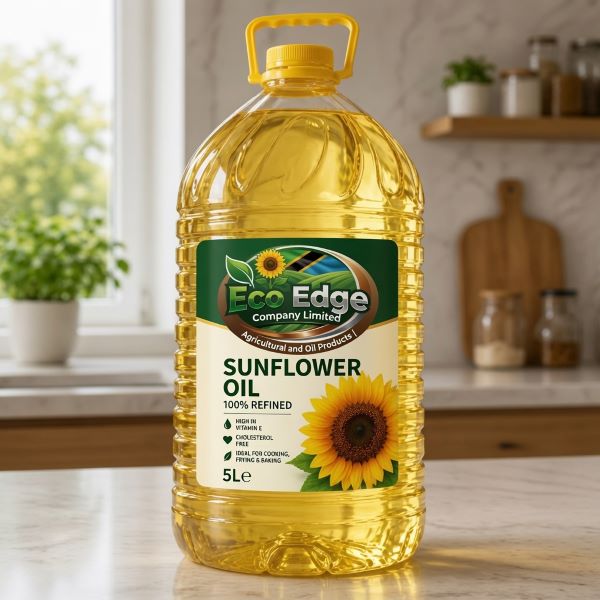
- Eco Edge Company Limited supplies retail packs (1 L, 3 L, 5 L, 10 L, 20 L) and bulk shipments (drums, IBC totes, flexitanks) with full export documentation, including for EU/Italian buyers.
What Is Sunflower Oil?
Sunflower oil is a non-volatile edible oil pressed or extracted from the seeds of the sunflower plant (Helianthus annuus). It is light in colour and taste, high in vitamin E and unsaturated fatty acids, and widely used for frying, baking, salad dressings, food manufacturing, cosmetics and, increasingly, biofuel feedstock. In Tanzania and across East Africa, it is prized as a healthier, locally grown alternative to imported palm oil.
Crude vs. Refined Sunflower Oil
- Crude sunflower oil is the raw oil obtained straight from pressing or solvent extraction of sunflower seeds. It retains gums, waxes and free fatty acids, and is normally sold to refineries and industrial processors. See our crude sunflower oil product page for specifications.
- Refined sunflower oil (RBD) has been degummed, neutralised, bleached and deodorised, giving a clear, pale-gold oil with a neutral taste and high smoke point (around 225–230 °C) — ideal for household cooking, deep-frying and food production. Order it on our refined sunflower oil Tanzania page.
Linoleic vs. High-Oleic Varieties
Standard linoleic sunflower oil is rich in polyunsaturated omega-6 fatty acids, while high-oleic sunflower oil contains 75%+ monounsaturated oleic acid, giving it superior oxidative stability for repeated deep-frying and longer shelf life. Restaurants, snack manufacturers and hotels in Europe increasingly specify high-oleic grades. Tell our team which fatty-acid profile your application requires when you request a quote via our contact page.
Why Buy Sunflower Oil from Tanzania?
According to the United Nations Industrial Development Organization (UNIDO), Tanzania ranks among the world’s top ten sunflower oilseed producers, and the International Trade Centre documents how Tanzanian sunflower exports surged from roughly US$1 million to over US$70 million within a decade, with yields rising sharply as improved seed varieties and modern crushing capacity spread. The Bank of Tanzania identifies sunflower as one of the country’s most strategic crops, and the government’s Sunflower Sector Development Strategy continues to channel investment into seeds, extension services and refining capacity.
For buyers, this translates into five practical advantages:
- Naturally grown, largely non-GMO crop. Tanzanian sunflower is overwhelmingly cultivated by smallholder farmers under rain-fed conditions with minimal chemical inputs — the same farming culture behind our non-GMO yellow maize and sesame seeds.
- Competitive origin pricing. Proximity to the seed source keeps crushing and logistics costs low compared with re-exported oils.
- Strategic port access. The Port of Dar es Salaam offers direct container and flexitank routings to Mediterranean ports such as Genoa, La Spezia and Naples — a key advantage for Italian and wider EU importers.
- Supply diversification. With Black Sea supply chains still volatile, European food companies are actively qualifying African origins to de-risk their sunflower oil procurement.
- Social impact. Every litre purchased supports Tanzanian smallholder farming families — a story that resonates with today’s ethically minded consumers. Learn more about our community work on our donation and impact page.
Tanzania Sunflower Sector at a Glance
| Indicator | Detail |
|---|---|
| Global ranking | Top-10 sunflower oilseed producer (UNIDO) |
| Main growing regions | Singida, Dodoma, Shinyanga (“Central Sunflower Corridor”), plus Iringa, Rukwa, Mbeya and Manyara |
| Harvest season | Approximately June – September (main crop) |
| Key export products | Sunflower seeds, crude oil (HS 1512.11), refined oil (HS 1512.19), seed cake for animal feed |
| Export documentation | Certificate of Origin, phytosanitary/health certificates, Certificate of Analysis, TBS quality certification |
| Main export gateway | Port of Dar es Salaam |
Benefits of Sunflower Oil
Why do households, chefs and manufacturers keep choosing sunflower oil over alternatives such as palm oil, soybean oil or canola oil? The answer lies in its nutrition profile, Buy Sunflower Oil from Tanzania, cooking performance and versatility.
Health & Nutrition Benefits
- Rich in vitamin E: one of the most concentrated dietary sources of this antioxidant, which supports skin health and protects cells from oxidative stress (see the nutrient profile in the USDA FoodData Central database).
- Heart-friendly fat profile: low in saturated fat and free of trans fats and cholesterol; replacing saturated fats with unsaturated fats is consistent with the dietary guidance of the World Health Organization.
- Light taste and aroma: lets the flavour of food shine through — a major reason Tanzanian consumers prefer it to palm oil for everyday cooking.
- Naturally allergen-friendly: a practical alternative for kitchens avoiding peanut or soy oils (though we also stock quality peanut oil and avocado oil for those who want them).
Cooking & Foodservice Benefits
- High smoke point (~225–230 °C for refined grades): ideal for deep-frying chips, chicken, samosas, mandazi and snack foods.
- High-oleic stability: extended fry-life reduces oil change frequency and total cost for restaurants and hotels.
- Neutral base for dressings, mayonnaise and margarine production.
- Clean label appeal: “sunflower oil” is a single, recognisable ingredient consumers trust.
Cosmetic & Industrial Benefits
- Skincare and haircare: its linoleic acid and vitamin E content make it a popular emollient in lotions, soaps and hair oils.
- Bio-lubricants and biofuels: crude sunflower oil and used cooking oil (UCO) serve as renewable feedstocks for biodiesel and sustainable aviation fuel programmes aligned with EU green-energy mandates.
- Animal feed by-product: sunflower seed cake pairs naturally with our soybean meal and wheat bran for livestock rations.
Refined vs. Crude Sunflower Oil: Which Should You Buy?
| Feature | Crude Sunflower Oil | Refined Sunflower Oil (RBD) |
|---|---|---|
| Appearance | Amber, may be slightly cloudy | Clear, pale gold |
| Taste & aroma | Distinct seedy/nutty notes | Neutral |
| Smoke point | Lower (~107 °C unrefined) | High (~225–230 °C) |
| Typical buyers | Refineries, biodiesel plants, industrial processors | Households, restaurants, retailers, food manufacturers |
| Packaging | Flexitanks (approx. 20–24 MT), ISO tanks, drums | 1 L–20 L bottles/jerricans, drums, IBC totes, flexitanks |
| Where to order | Buy crude sunflower oil | Buy refined sunflower oil |
Sunflower Oil Price in Tanzania: What Determines What You Pay
One of the most searched questions online is the sunflower oil price in Tanzania — including the popular sunflower oil Tanzania 1 litre and 5 litre sunflower oil price in Tanzania queries. Because sunflower oil is a globally traded commodity, prices move week to week. Rather than publishing figures that go stale, we explain the drivers and invite you to request a current sunflower oil Tanzania price list at any time.
- Seed harvest and season: prices typically soften after the June–September harvest and firm up in the lean season before the next crop.
- Global vegetable-oil benchmarks: Black Sea sunflower, Malaysian palm and Chicago soybean oil futures all influence East African pricing.
- Grade and variety: refined costs more than crude; high-oleic commands a premium over standard linoleic oil.
- Packaging format: per-litre cost falls as you move from 1 L retail bottles to 20 L jerricans, drums, IBC totes and flexitanks.
- Volume and contract length: full-container-load (FCL) and annual supply contracts unlock the best rates.
- Incoterms and destination: EXW Dar es Salaam, FOB Dar es Salaam, or CIF Genoa/Naples each carry different freight and insurance components.
 Get today’s price list: Email info@ecoedgecompanylimited.org or use our contact form with your required grade, pack size, volume and destination port. We respond with a dated, itemised quotation — the reliable alternative to outdated “price list” pages.
How to Buy Sunflower Oil from Tanzania Online: Step by Step
Whether you found us searching buy sunflower oil from Tanzania online or refined sunflower oil for sale Dar es Salaam, ordering from Eco Edge Company Limited follows the same simple process:
- Browse and enquire. Visit our refined sunflower oil or crude sunflower oil product pages and send your requirements, or explore our full sunflower oil for sale in Tanzania overview.
- Receive specifications and quotation. We share a Certificate of Analysis template (free fatty acid %, peroxide value, moisture, colour), packaging options and a dated price quote.
- Confirm samples (optional). Export buyers may request pre-shipment samples for laboratory verification.
- Sign the sales contract. Quantities, Incoterms, payment terms (e.g., T/T, L/C for large export orders) and delivery schedule are agreed in writing.
- Quality control and loading. Oil is filled into food-grade packaging or flexitanks; third-party inspection (e.g., SGS/Bureau Veritas) can be arranged on request.
- Shipping and documentation. We handle the Bill of Lading, Certificate of Origin, health/phytosanitary certificates and Tanzania Bureau of Standards documentation, then share tracking details until delivery.
Exporting Tanzanian Sunflower Oil to Italy and the EU
Italy is one of Europe’s largest consumers of sunflower oil — used everywhere from industrial frying and snack production to conserve packing and foodservice. For Italian importers, Tanzanian origin offers competitive pricing, a non-Black-Sea supply lane, and direct maritime routings from Dar es Salaam to Genoa, La Spezia, Naples and Trieste.
Eco Edge Company Limited prepares EU-compliant shipments aligned with European food-safety law, including the general requirements enforced under the European Commission’s food safety framework and the scientific standards assessed by the European Food Safety Authority (EFSA). Typical export documents for an Italian consignment include:
- Commercial invoice and packing list
- Bill of Lading (FCL container or flexitank)
- Certificate of Origin (chamber-certified)
- Certificate of Analysis from an accredited laboratory
- Health certificate and, where applicable, phytosanitary certification
- Tanzania Bureau of Standards (TBS) quality certification — see tbs.go.tz
Importers can verify Tanzanian trade procedures via the Tanzania Trade Development Authority (TanTrade) and global sunflower market data through the FAO oilcrops market portal. If you’re building a longer-term East Africa sourcing programme, read about opportunities to partner and invest with Eco Edge Company.
Who Buys Sunflower Oil from Tanzania?
Households & Retail Consumers (B2C)
Health-conscious families choose refined sunflower oil to manage cholesterol and avoid trans fats; budget-minded shoppers value it as an affordable, versatile pantry staple; and premium shoppers seek cold-pressed or high-oleic options. Retail packs (1 L, 3 L, 5 L, 10 L, 20 L) are available across Tanzania, including through the trading hub covered in our guide to the Kariakoo market in Dar es Salaam.
Restaurants, Hotels & Food Manufacturers (B2B)
Foodservice operators buy 20 L jerricans and drums for deep-frying and sautéing — with high-oleic grades preferred for fry-life. Manufacturers of chips, snacks, mayonnaise, margarine, baked goods and infant nutrition source bulk RBD sunflower oil under annual contracts, often alongside our refined vegetable oil, corn oil and rapeseed oil lines.
Cosmetics & Industrial Buyers
Personal-care manufacturers use sunflower oil for its antioxidant and skin-hydration properties, while biofuel and bio-lubricant producers procure crude oil and UCO as renewable feedstock to meet sustainability mandates.
Expert Insights: What Smart Buyers Check Before Ordering
- Insist on a recent Certificate of Analysis. Key refined-oil parameters: free fatty acid ≤ 0.1% (as oleic), peroxide value ≤ 10 meq O₂/kg (lower is fresher), moisture ≤ 0.1%, clear colour and neutral odour.
- Match the grade to the application. Deep-fry operations should specify high-oleic; salad-dressing producers may prefer standard linoleic for its lighter mouthfeel.
- Check packaging integrity for tropical transit. Food-grade HDPE/PET with tamper-evident caps for retail; new food-grade flexitank liners for bulk.
- Plan around the harvest calendar. Booking volumes during or just after the June–September crush usually secures better pricing and allocation.
- Verify the supplier. Review our company profile, services and awards and recognition — then ask for trade references. Legitimate exporters welcome due diligence.
Common Mistakes When Buying Sunflower Oil in Bulk
- Chasing “too good to be true” prices. Quotes far below the global market usually signal adulteration, non-existent stock or advance-fee fraud. Cross-check against FAO and trade benchmarks.
- Ignoring Incoterms. An EXW price is not comparable to a CIF price; always compare landed cost at your warehouse.
- Skipping pre-shipment inspection on first orders. A modest SGS/BV inspection fee protects a five- or six-figure consignment.
- Ordering the wrong fatty-acid profile. Standard linoleic oil in a heavy deep-fry operation degrades faster and costs more over time than high-oleic.
- Underestimating documentation lead time. EU-bound shipments need certificates prepared before vessel cut-off — start paperwork when you sign the contract, not when the container is packed.
- Poor storage after delivery. Heat, light and oxygen degrade oil; store below 25 °C, away from sunlight, in sealed containers.
Best Practices for Importers and Distributors
- Start with a trial container, then scale to quarterly or annual contracts with agreed price-review mechanisms.
- Diversify pack formats: combine retail bottles for supermarket lines with drums or flexitanks for industrial clients in the same container programme.
- Lock shipping windows early during peak season on the East Africa–Mediterranean trade lane.
- Bundle complementary products to optimise container utilisation — many of our sunflower oil buyers co-load cashew kernels, Arabica coffee, vanilla beans, black pepper or cloves.
- Keep a compliance file of every COA, health certificate and lot number for traceability audits.
- Stay informed: follow sector updates on our news page and global market signals via the FAO Food Price Index.
Why Choose Ecoedgecompanylimited.org to Buy Sunflower Oil?
- Origin-direct sourcing: we work with growers and crushers in Tanzania’s Central Sunflower Corridor, shortening the chain between farm and buyer.
- Full grade range: crude, refined, standard linoleic and high-oleic sunflower oil — plus a complete edible-oils portfolio including avocado, peanut, canola, corn, soybean and palm oil.
- Flexible order sizes: from retail cartons for Dar es Salaam distributors to multi-container export programmes for Europe, the Middle East and Asia.
- Documentation done right: COA, Certificate of Origin, TBS certification and EU-ready health certificates handled in-house.
- Transparent communication: dated quotations, written contracts, and a named account contact from enquiry to delivery — see our FAQs and privacy policy for how we work.
- Recognised and accountable: read about our track record on the award-winning Eco Edge Company page.
People Also Ask
Does Tanzania export sunflower oil? Yes. Tanzania exports both crude and refined sunflower oil, alongside sunflower seeds and seed cake. Export destinations include European markets (Switzerland and the Netherlands among recent buyers of crude oil), the Middle East, Asia and neighbouring African countries.
Is sunflower oil from Tanzania good quality? Yes — when sourced from a reputable supplier with laboratory certification. Tanzanian sunflower is largely smallholder-grown and non-GMO, and refined grades meet international parameters for free fatty acids, peroxide value and moisture.
Which regions of Tanzania produce sunflower oil? The Central Sunflower Corridor — Singida, Dodoma and Shinyanga — leads production, with significant volumes also from Iringa, Rukwa, Mbeya, Manyara and the Southern Highlands.
What is the sunflower oil Tanzania contact number for orders? The fastest way to reach Eco Edge Company Limited is via info@ecoedgecompanylimited.org or the phone details published on our contact us page.
Frequently Asked Questions (FAQ)
1. How can I buy sunflower oil from Tanzania online?
Place an enquiry on our refined sunflower oil product page or email info@ecoedgecompanylimited.org with your grade, pack size, quantity and destination. You’ll receive specifications and a dated quotation, after which we confirm the order by contract and arrange delivery or export shipment.
2. What is the current sunflower oil price in Tanzania?
Prices change with the seed harvest, global vegetable-oil benchmarks, grade and packaging, so any fixed figure published online quickly goes stale. Request today’s price list — including 1 litre, 5 litre, 10 litre, 20 litre and bulk flexitank rates — through our contact page and we will reply with a dated quotation.
3. Does Tanzania export sunflower oil to Europe and Italy?
Yes. Tanzanian crude and refined sunflower oil ships in containers and flexitanks from the Port of Dar es Salaam to Mediterranean ports including Genoa, La Spezia and Naples, with EU-compliant documentation (COA, Certificate of Origin, health certificates).
4. What is the minimum order quantity (MOQ)?
Local buyers can order from a few cartons; export buyers typically start at one full container load (FCL). Flexitank shipments of crude oil are usually around 20–24 metric tonnes per container. Contact us for tailored MOQs.
5. What packaging options are available?
Retail PET bottles (1 L, 2 L, 3 L, 5 L), 10 L and 20 L jerricans, 200 L food-grade drums, 1,000 L IBC totes, and food-grade flexitanks for bulk export. Private-label packaging can be discussed for volume contracts, and we also supply jute gunny bags for dry commodities shipped alongside oil orders.
6. What is the difference between refined and crude sunflower oil?
Crude oil is the raw pressed/extracted oil sold mainly to refineries and industrial users; refined (RBD) oil has been degummed, neutralised, bleached and deodorised for direct cooking use, with a neutral taste and high smoke point.
7. Is Tanzanian sunflower oil non-GMO?
Tanzanian sunflower is conventionally bred and predominantly grown by smallholder farmers; there is no commercial GMO sunflower cultivation in Tanzania. Non-GMO declarations can be provided with shipment documentation on request.
8. How should I store sunflower oil?
Keep it sealed, below 25 °C, away from direct sunlight and strong odours. Properly stored refined sunflower oil typically holds quality for 12–18 months from production; check the best-before date on each lot.
9. Can I get high-oleic sunflower oil from Tanzania?
Yes — high-oleic lots are available subject to seasonal seed supply. Specify your required oleic-acid percentage and application (e.g., continuous deep-frying) in your enquiry so we can match the correct lot and provide a fatty-acid profile.
10. What payment terms do you accept?
Local orders: bank transfer or mobile money on agreed terms. Export orders: telegraphic transfer (T/T) with deposit/balance structure, or Letter of Credit for larger contracts. Full terms are stated in every sales contract.
11. Who are the main sunflower oil manufacturers in Tanzania?
The sector includes large millers with solvent-extraction refineries plus hundreds of SME crushers clustered around Singida and Dodoma. Eco Edge Company Limited aggregates and quality-controls supply from vetted processors, giving buyers a single accountable export counterpart. Learn more about Eco Edge Company Limited.
12. Do you supply other Tanzanian agro-commodities?
Yes — including raw cashew nuts, green coffee beans, cocoa beans, pigeon peas, red kidney beans, green mung beans, chickpeas, wheat grain, UG Grade A sisal fibre, ICUMSA 45 white sugar and agricultural inputs such as NPK, DAP and Urea N46 fertilizer.
Conclusion: Order Pure Tanzanian Sunflower Oil Today
From the sun-drenched fields of Singida and Dodoma to kitchens in Dar es Salaam and factories in Italy, Tanzanian sunflower oil delivers on quality, value and supply security. Whether you need a single carton of 5-litre bottles, drums for a hotel kitchen, or flexitank consignments for an EU refinery, Eco Edge Company Limited is your origin-direct partner to buy sunflower oil from Tanzania with confidence.
 Ready to order? Email info@ecoedgecompanylimited.org, visit our contact page, or go straight to refined sunflower oil and crude sunflower oil to request today’s quotation. Fast responses, verified quality, worldwide shipping.
Location
-
Biei, Hokkaido, Japan





Add a review